



What is fleet management?
A fleet comprises all the vehicles owned or leased by a company for its activities. This fleet may be dedicated to transporting goods or people, depending on the organization’s specific needs. Fleet management involves the complete supervision of vehicles throughout their lifecycle within the fleet
Fleet management enables a director or designated manager to obtain an overview of all the means of mobility owned by his or her company. What’s in it for you? Daily monitoring of the fleet.
What are the challenges of fleet management?
Fleet management presents major challenges for companies. Cost optimization, driver safety, economic, ecological and regulatory considerations… We explain everything.

1. Save money in the short, medium and long term
– Reducing vehicle fleet costs means optimizing logistics costs, including fuel, maintenance and insurance.
– Calculating and understanding your TCO (Total Cost of Ownership) is essential to effectively assess and manage the expenses associated with each vehicle in your fleet.
What is TCO?
Total Cost of Ownership (TCO) refers to the total amount spent by the user of an asset during its life cycle within the company.in the case of fleet management, TCO encompasses all costs relating to vehicles, including purchase or rental, maintenance, storage, etc.tCO calculations take into account both direct and indirect costs. It’s an interesting indicator to calculate when it comes to controlling fleet costs. Note that it can vary from company to company

2. Ensuring driver safety
Fleet management also involves ensuring the safety of drivers, which means :
– Prevent the risk of accidents by ensuring strict control of vehicles;
– plan maintenance tasks ;
– train drivers in proper vehicle maintenance.
3. Respecting environmental issues
The regulations now in force in Europe concerning pollutant gas emissions are forcing companies to manage their fleets. In France, the “Loi d’Orientation des Mobilités” requires private companies with fleets of over 100 vehicles to meet quotas for low-emission vehicles when renewing their fleets.to comply with these regulations, several solutions can be envisaged. For example, the acquisition of vehicles with minimized CO2 emissions, or raising drivers’ awareness of eco-driving techniques.
Fleet management tools
to help you on a daily basis?
Managing a fleet of vehicles is an essential function, as it influences the company’s profits and general operations. Also known as Car Fleet Management, this involves looking after vehicles, maintenance, leasing, taxation, choice of cars, etc. Fleet management can take different forms, depending on the size of the company, the number of vehicles in the fleet and the company’s needs. To ensure effective fleet management, we particularly recommend the use of a company car policy and decision-making tools..
Optimized fleet management: 3 essential tools
1: The Car Policy
The Car Charter, also known as the Car Policy, plays an essential role in defining the rules for the use and allocation of vehicles within a company. It provides employees with a catalog of pre-selected vehicles to suit their specific needs. Drawn up in collaboration with the company’s general management, fleet manager, drivers and finance department, it regulates the use of vehicles for professional activities. Although the introduction of a vehicle charter is not compulsory, it is strongly recommended to involve all stakeholders and make the day-to-day management of the fleet safer and simpler.

2: Telematic boxes
These units provide a wealth of information relevant to fleet management. And for good reason: they not only record itineraries, but also driver behavior (compliance with speed limits, routes defined by the fleet manager, etc.). With these, the fleet manager can deduce information on fuel consumption or the lifespan of parts, for example. Depending on the service provider, telematics units can also be used to analyze factors such as mileage.
Did you know? It’s possible to install telematics boxes in your commercial vehicles or other vehicles! However, most new vehicles are equipped with original equipment units, which provide the same information as the telematics version.
3: Fleet management software
Fleet management software offers a complete solution for optimizing efficient fleet management, by collecting and centralizing precise information. These tools enable you to collect a wide range of data, such as :
- inventory of your vehicles ;
- maintenance and other related costs;
- integration of your supplier data (rental companies, oil companies, electric recharging);
Fleet management software automatically integrates this data, eliminating the need for time-consuming manual entry, and offering automatic calculation functions for taxes, non-deductible depreciation (NDA), etc. The result: this automation frees the fleet manager to concentrate on higher value-added tasks. The result: this automation frees the fleet manager to concentrate on higher value-added tasks.
Fleet manager:
what are its missions?
Should you outsource or insource your vehicle flow management?
Outsourcing :
On the one hand, a company can call on an external service provider, known as a fleeter. The latter is responsible for all aspects of fleet management, whether administrative, technical, logistical or human, thanks to its team of experts.this option is a major advantage when the company wishes to concentrate its employees on their core business, or when it does not have an in-house person with all the skills required for the job.
Internalize :
On the other hand, insourcing means appointing a person within the company to act as fleet manager. This person will be entirely dedicated to his or her tasks, which require versatility and constant attention. The main objective in both cases is to keep the TCO (Total Cost of Ownership) as low as possible. The fleet manager, or fleeter, relies on KPIs (key performance indicators) to make strategic decisions tailored to the company’s needs.
The role of the fleet manager
The vehicle fleet manager is responsible for ensuring compliance with the law of the road for each vehicle in the company fleet, particularly in the context of long-term leasing contracts.
And for good reason: the rental amounts are based on the planned mileage, but this can vary, distorting the rolling law. The manager must then adjust the amounts via endorsements, requested from the rental companies after careful monitoring of the rolling laws.
To facilitate this process, flow grids (pricing matrix) can be requested from rental companies, guaranteeing optimal management of rental costs.
Vehicle maintenance management is one of the fleet manager’s key missions. This helps to avoid additional costs and ensureoptimum vehicle life. The mission includes tasks, such as:
- technical inspections (failure to carry out these inspections is considered an offence!);
- oil changes ;
- revisions, etc.
Although manufacturer’s maintenance is not compulsory, it is strongly recommended to ensure proper engine operation, extend vehicle life and avoid loss of the manufacturer’s warranty.
In addition to monitoring the condition ofengines and brakes, the fleet manager must pay particular attention to tires. It’s essential to regularly check their condition and maintain optimum pressure. Not forgetting the rotation of summer and winter tires, which is a mandatory practice since the introduction of the Loi Montagne II in 2021.
The fleet manager’s job is to manage claims. This involves contacting the insurer to declare claims and trigger compensation, as well as ensuring the loan of a new vehicle if necessary.
Since 2017, companies have had todesignate vehicle drivers, a task that can be automated to save time. In addition, automating or centralizing the processing of fleet-related fines is recommended for more efficient administrative management.
The fleet manager knows neither the external condition nor the mileage of the vehicle at any given moment. Only a regular mileage survey enables him to monitor the contract’s running law and plan the necessary maintenance, while keeping track of the vehicle’s average consumption.
Assiduous supervision of the bodywork helps avoid high reconditioning costs when returning the vehicle, or a lower price when reselling.
Note that optimizing the stages of vehicle delivery, acquisition, return and renewal can bean additional optimization lever for fleet management.
As the driver is the only person who sees the vehicle on a regular basis, it is crucial to make him/her aware of his/her responsibilities, in particular through :
- training in eco-driving,
- bonuses for good behavior upon return of the vehicle, or even
- the challenges for the best driver,
- awareness of road safety – which also helps to prevent vehicle accidents
At the same time, the fleet manager must stay informed about taxation and environmental standards which are constantly evolving, such as :
- wLTP standard;
- bonus-malus ;
- crit’Air stickers;
- cO2 emissions ;
- the ever-increasing proportion of electric vehicles, etc
This watch enables him to communicate any changes to employees and avoid any impact on Total Cost of Ownership (TCO). Also, breaches such as failure to report infringements or errors in tax calculations can result in heavy fines or even criminal penalties. You also need to be careful to handle drivers’ personal data correctly in order to comply with the RGPD that arrived in 2018.
Vehicle fleet: how to improve
performance and cut costs?
Fleet management software
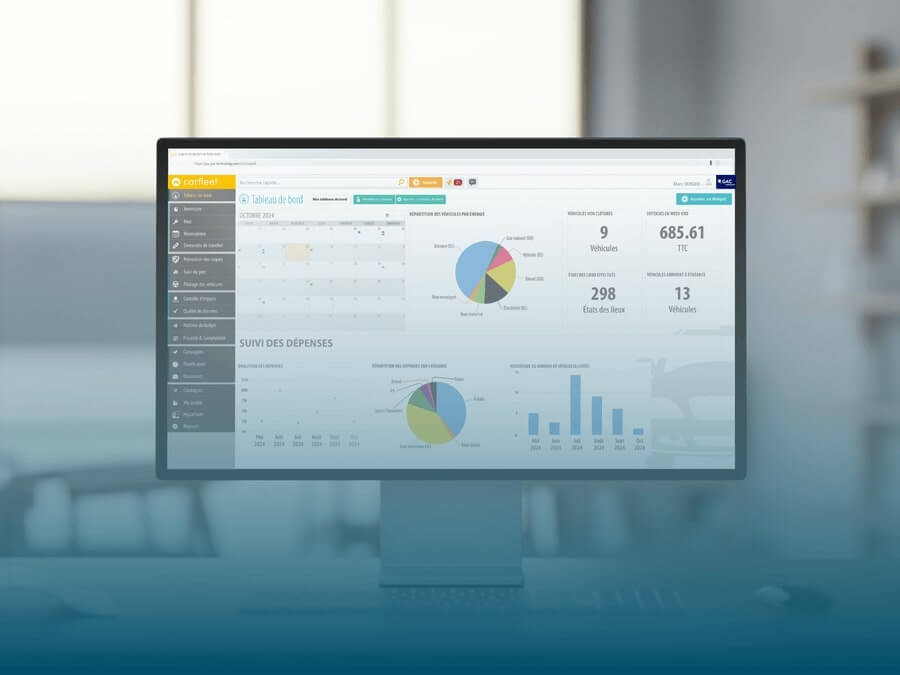
Fleet management software centralizes all fleet data and information, including supplier financial data, making it accessible at the click of a button.this centralization not only facilitates day-to-day fleet management, but also ensures that information is available to other employees, thanks to intuitive dashboards.
GAC Car Fleet: the No. 1 fleet management software
GAC Car Fleet is an example of a software package that supports fleet managers in their day-to-day tasks. It covers the entire fleet management process, from vehicle reception to return or sale. Our software enables you to :
- efficiently manage your fleet ;
- control your fleet costs;
- centralize all your vehicle data;
- comply with current regulations.
Optimize TCO with fleet management software
Some software packages offer the option of calculating and tracking TCO, giving you a better understanding of your expenses. With GAC Car Fleet, this vision is daily, monthly and global. TCO is calculated for each vehicle as well as for your entire fleet.the cost calculation, monitoring and analysis functions enable you to optimize your TCO, which translates into significant savings. And there are a number of best practices you can implement to optimize your TCO.
Opt for a centralized solution
All the indicators linked to fleet management are essential, but sometimes difficult to gather… The ideal solution? Centralize the various pieces of information and make them accessible to all internal stakeholders using dedicated software!of course, you can manage access by creating specific profiles for different employees: administrator, read-only, or limiting access to certain modules only. With the impact of fleet management on numerous departments such as accounting, purchasing, human resources and finance, it becomes difficult to keep everything up to date and analyze data efficiently, especially for large fleets. However, various technological solutions exist to simplify the daily life of the fleet manager. The advantages of a good centralized solution are numerous:
- save time on a daily basis thanks to automatic integration of supplier, government and internal data (SIV);
- help in optimizing your fleet’s costs (TCO, tax on CO2 emissions and tax on atmospheric pollutants, rolling law, etc.);
- a guarantee of being up to date and in compliance with current regulations (LOM law, WLTP standard, Climate and Resilience law, etc.).
GAC Car Fleet: centralize your fleet management
From the integration of a vehicle into your fleet, through its sale or return after a leasing contract, to financial management, GAC Car Fleet covers the entire fleet management process
Discover the software’s main features!
MANAGE – An overview for optimum fleet management
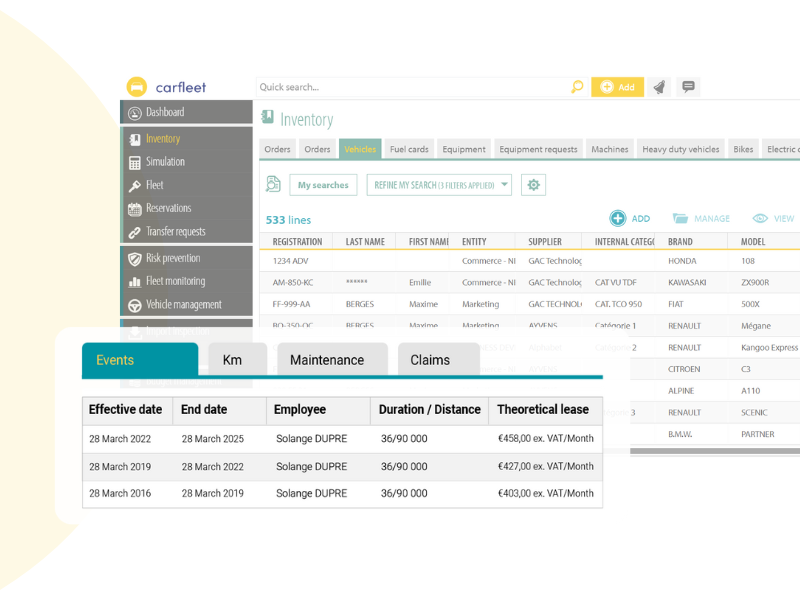
- A-to-Z vehicle tracking: inventory, detailed datasheets, history, contracts, equipment, reservations.
- Organisation of pool vehicles: request management, integrated schedule, real-time availability.
- Management of orders, fuel cards, machinery, bicycles and heavy goods vehicles.
OVERSEE – From maintenance management to offences
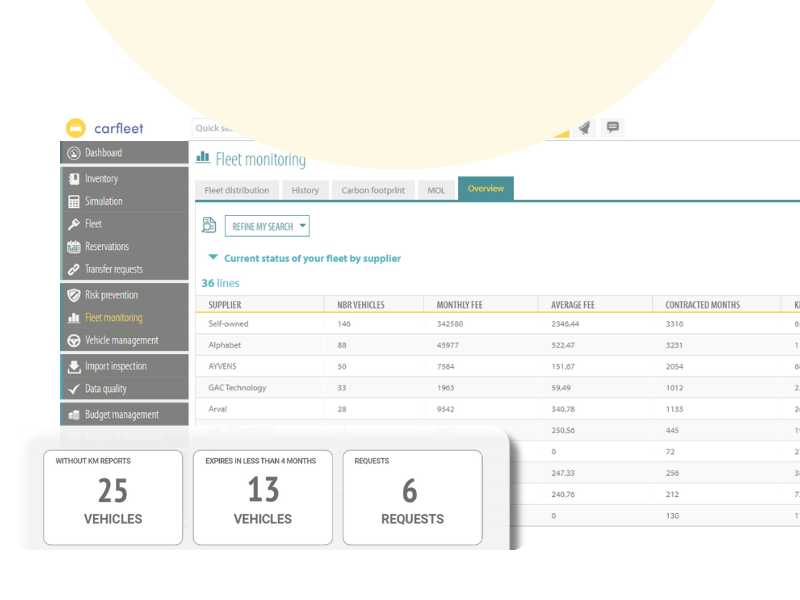
- Cost tracking (fuel, maintenance, fines, etc.)
- Analysis of driving behaviour, fuel consumption, eco-driving
- Monitoring claims, fines and maintenance
- Measuring the carbon footprint and integrating MOL data
CHECK – From analysing costs to tracking mileage
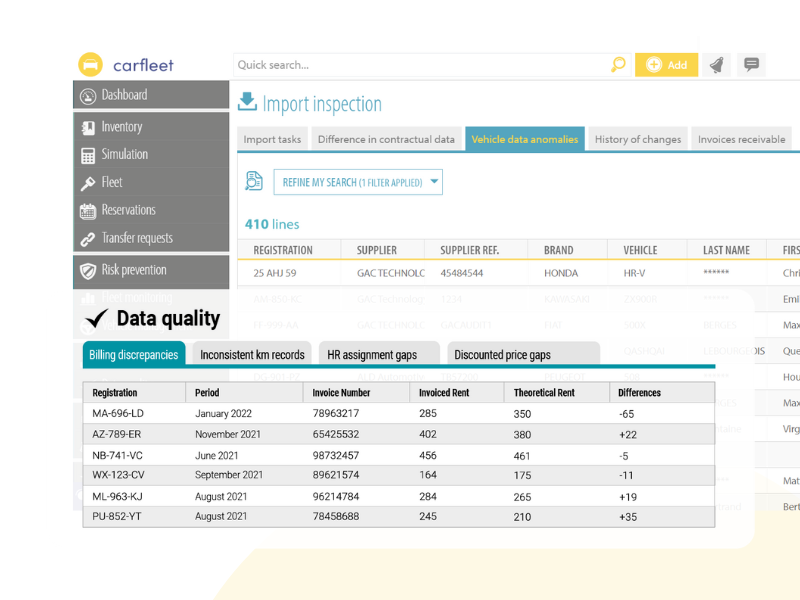
- Smart detection and correction of billing and mileage reading deviations
- Monitoring supplier imports: insurance, leasing, fuel, maintenance, etc.
BUDGET – From controlling costs to managing fleet taxation
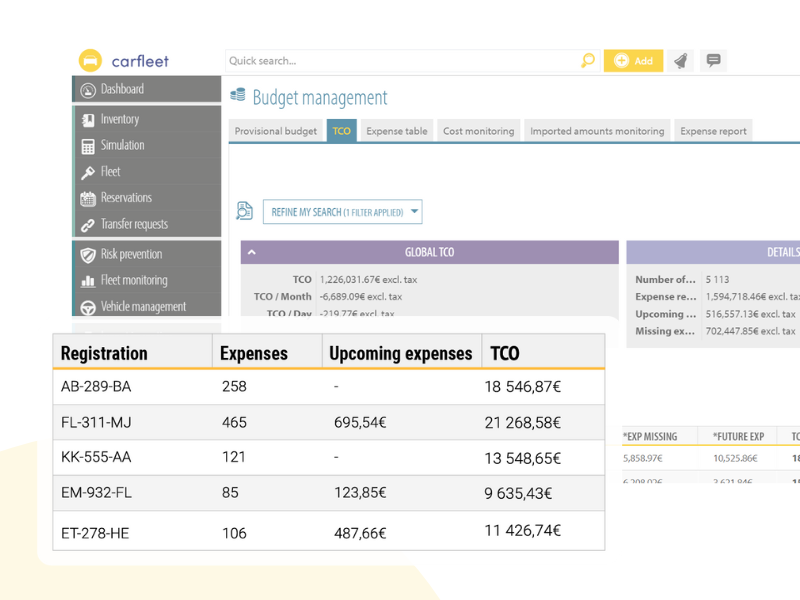
- Monitoring and optimising TCO, CPM, depreciation, actual costs
- Automated tax management (CCT, CO2, pollutants, axle tax, etc.), benefits in kind, accounting checks, etc.
- Analysis of deviation by vehicle, cost centre or period
COMMUNICATE – Targeted campaigns and simplified data collection processes
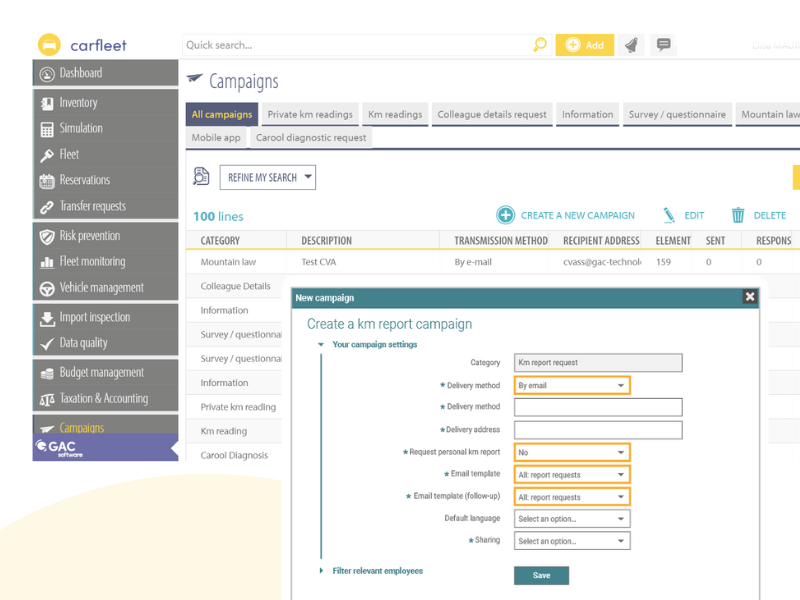
- Collection of mileage records, driving licences, questionnaires via email or the MyCarFleet mobile app, plus any other essential fleet management information or
- Customisable reports and Excel or PDF exports
CONFIGURE – From customised settings to access management
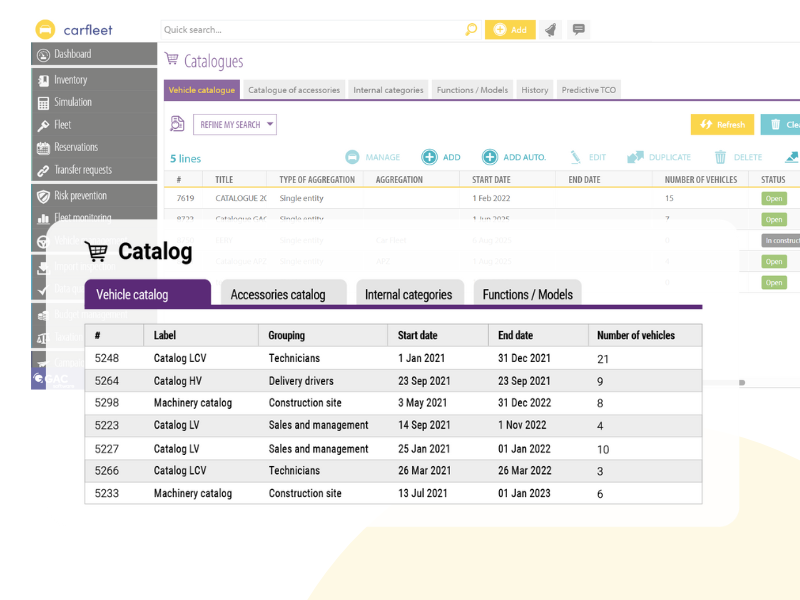
- Management of user rights, entities, organisation charts, email templates, etc.
- Creation of your Car Policy and vehicle catalogue (based on JATO)
The 3 exclusives in GAC Car Fleet :
- Predictive TCO calculation module: enables you to estimate the cost of a vehicle before you even order it.
- The function for selecting vehicles that meet criteria set by you, in line with your corporate policy.
- The TCO comparison tool between a combustion vehicle and a hybrid or electric vehicle.
With over 16 years’ experience in fleet management software, GAC Technology is a trusted partner for fleet managers on a daily basis. Our comprehensive tool is available in SaaS mode (100% web-based) and is used by over 500 companies, whether they have fleets of 30 or 35,000 vehicles, be they private individuals, commercial vehicles or trucks!